Showing posts with label Bible. Show all posts

Friday, November 11, 2016

Why I'm Not Taking the Time or Spending the Energy to Debate the Trinity

Most commenters on this blog stay on topic. I appreciate that. One of the unwritten rules of blog interaction is that the topic of the post should also be the topic of the comments.

A few times recently at least one commenter has repeatedly called into question the doctrine of the Trinity. This would be fine if I had, in fact, been blogging about the Trinity. However, I was not (and thus I did not post all of the anti-Trinity comments). It has been a long time since the Trinity was the primary focus of any blog post of mine.

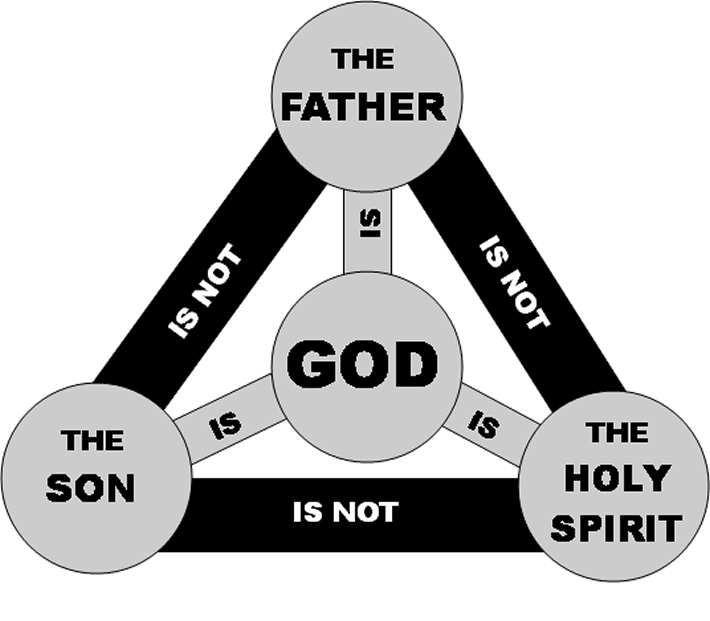
While I love the Trinity, I have no intention of taking the time or spending the energy on debating this doctrine. Why not? There are several reasons. First and primarily, I believe the doctrine is very clear according to scripture. One great example occurs at Jesus' baptism. I could go on and on. It is so clear that debating it is pointless.

Furthermore, within the church as a whole this is a largely settled debate. The church has agreed on the truth of the Trinity for hundreds upon hundreds of years. This is different, for example, from the debate about ecclesiology. Numerous dissenters have always existed against institutional Christianity since very early on (see here for more on that). Not so for the Trinity. I'm not suggesting that all Christians have always been convinced of the truth of the Trinity, but rather that no significant number has failed to adhere to it.

I'm also not going to debate the Trinity because plenty of other paces exist to do so. If you desire to bring up the topic, please do so there. Beyond that, I simply see no benefit in the debate. I don't know what can be gained by discussing in detail something that is, at least in my mind, so clear scripturally. I'd rather talk about, and wrangle over, something that needs to be discussed: the state of the church.

So there it is. If you want to debate the Trinity please do so in other forums. This is not the place. Thank you.

Monday, November 7, 2016

If You Knew Nothing of Christianity, But Then Found a Bible and Read It, What Would You Expect Church Gatherings to Be Like?

In this particular post I'm simply asking a question of you. Please put your answers in the comments section. Maybe we can begin an interesting and edifying discussion. My purpose in this is not to discuss what's wrong with the institutional church, but rather to focus on what can be right when we follow the Biblical pattern for meeting.

QUESTION: As much as you can, pretend that you know absolutely nothing of Christianity. You find a Bible and begin to read it. Based on what you see instructed to us and modeled for us in scripture, what would you expect church gatherings to be like?

Wednesday, October 19, 2016

Four Excellent Books on Biblical Interpretation

Some Christians struggle to interpret the bible correctly but wish they could do so. Others don't interpret it correctly and don't seem to care. Additionally, some passages are tough for just about anybody to comprehend. Because of all this, it's critical that we, Christ's church, do our best to understand what God is saying in scripture. One reason for the general impotence of the church in this country is that many Christians fail when interpreting what the bible means.

I'd like to recommend four excellent books that focus specifically on biblical interpretation. None are boring textbook types. Rather, they are enjoyable reads that you can work through without undue effort. I benefited from all four. I've previously written about them individually on this blog, but I'm grouping them together here in case you want to study a few at the same time.

In no particular order:

Exegetical Fallacies by D.A. Carson

This book is a classic. Part of that is because Carson is a both prolific and wonderful writer. In this short text (only 140 pages) he covers word-study fallacies, grammatical fallacies, logical fallacies, and presuppositional and historical fallacies. A basic knowledge of New Testament Greek helps quite a bit when reading this book; I wouldn't say it is required, but it is a large benefit. If I could recommend only one book on biblical interpretation this would be the one.

40 Questions About Interpreting the Bible by Robert Plummer

I love the layout of this book. The author asks and answers forty specific questions as the forty chapters. This is superb because it allows the reader to easily pick and choose which chapters to read. I'm also pleased that Plummer deals quite a bit with genre, which is an often ignored but critical issue.

Click here to read my full review of this book.

The Most Misused Verses in the Bible by Eric Bargerhuff

This book is a lot of fun to read. Bargerhuff's text is composed of eighteen chapters that focus on eighteen common, incorrect biblical interpretations. For example, he tackles "Do not judge," "Plans to prosper you and not to harm you," "Where two or three are gathered," "If my people who are called by my name," "Money is the root of all evil," "I can do all things through Christ who strengthens me," and several others. This would be a great book for any Christian to read, especially those who are first wading into the issue of biblical interpretation.

Click here to read my full review of this book.

Urban Legends of the New Testament by David Croteau

Croteau's book is similar to Bargerhuff's but a little more advanced. Urban Legends deals with forty poor interpretations specifically of New Testament passages. If you are more than a beginner in interpreting the bible, then I recommend this text over The Most Misused Verses in the Bible. Think of Bargerhuff's book as being more fun, but Croteau's as being more beneficial.

Click here to read my full review of this book.


For other reading on biblical interpretation, take a look at two blog series I've written on this subject:

Church, Bible, And Interpretation - It's Not So Simple
Old Testament Interpretive Problems Always Lead to Church Problems


Finally, enjoy:


Thursday, October 13, 2016

Adopted, Redeemed, and Sealed!

My favorite section of Ephesians is 1:3-14. In these twelve verses, which are actually one sentence in Greek, Paul describes for us a vast array of spiritual blessings that God has bestowed upon us. It is truly amazing.

The three blessings that jump off the page at me are adoption, redemption, and sealing. Because of God's grace and that alone, we are made His children, we are bought back from our sin debt, and we are secured for eternity. This is accomplished through the perfect working together of the Trinity. God the Father adopts, God the Son redeems, and God the Holy Spirit seals.

God's grace is stunning. Let's never cease being awestruck by the gift of salvation.

Wednesday, October 5, 2016

Ephesians Times Ten


Over the past month I've read through the epistle of Ephesians ten times in ten different bible translations. I did this for two reasons. First, I just love Ephesians. It is a treasure trove of glorious truths about both God and His church. Second, I wanted to see the different nuances of the various translations.

The translations I selected were (in alphabetical order) the ESV, HCSB, ISV, KJV, NASB, NET, NIV, NKJV, NLT, and YLT. I would have read the epistle in languages other than English, but sadly I am monolingual (at least I'm not monosyllabic).

I attempted to keep an open mind about all the translations. Each has its positives. That said, I do prefer some much more than others. The ESV and NKJV are my favorites. I also like the HCSB, ISV, KJV, NASB, NET, and YLT. I tolerate the NIV. The NLT is too simplistic (these, of course, are all my personal opinions; feel free to disagree).

I gained from all ten readings of the letter. Each time God showed me something different. I thank the Lord that we English speakers are blessed to have so many good translations available to us. I highly encourage you to select a book of the bible and read it through in various translations. If you are a relatively slow reader like me then I suggest a shorter book like Galatians, Ephesians, Philippians, Colossians, James, I Peter, or I John. After that you may decide to bite off something longer such as a Gospel account or Romans. Also, don't forget the Old Testament.

Enjoy!

Monday, September 26, 2016

A Bad Reason for Returning to the Institution: "Well, the New Testament is Simply Descriptive."


You may have departed from the institutional church framework because the bible shows something far different. However, would it bring doubts to your mind if another Christian said to you, "Well, the New Testament is simply descriptive."?

Again and again and again I've heard, read, and been told by believers that the New Testament narrative passages are only descriptive, not prescriptive. In other words, narratives simply tell us what happened, but do not call us to behave in that same manner.

When I departed from the salaried pastorate I ran into this argument repeatedly.

But is it a valid argument?

We learn much from the entire bible. In particular, the New Testament tells us many wonderful things about who God is, about what He has done, about what He is still doing, and about what our response should be. Because it is a book, the bible is literature (true literature). It is composed of all sorts of writing, from poetry and prophecy to narrative and epistle. It is all for our instruction.

If the narrative passages are only descriptive, as the above argument goes, then we lose a great deal of important information about how we are to live. Since much of the information in scripture about church life is, in fact, in narrative form we'd have little to go on if we toss the narrative sections aside. If that was the case, then churches could basically do whatever they want when they meet (which is what is happening in most churches today).

Interestingly, I've yet to meet even one Christian who consistently treats all narrative accounts as simply descriptive. Rather, the tendency is to say that the passages they agree with are prescriptive, but those they do not really like are only descriptive. We all have a tendency to fall into this trap and ought to be wary of it.

Much of Matthew, Mark, Luke, and John are narrative. Do the passages that tell us about how Jesus lived not apply to us because they are narrative in form? What about the majority of the book of Acts?

I believe that one of the main reasons the church in this country is generally in disarray is that the New Testament narrative passages have been largely ignored. This has led to churches doing whatever they think is a good idea whenever they think it. This has led to abject disaster.

The entire bible is breathed out by God and useful for our instruction. Because of this, the narrative passages do in fact carry prescriptive weight. They are models that we should follow. Of course, we must let scripture interpret scripture. Also, we would never follow the narratives that show us people behaving in a sinful manner. We should, however, do all we can to learn from the narratives that show us positives.

If someone tells you that narratives are simply descriptive, ask him why he thinks that. If he actually answers you, follow up by asking how this applies to the narratives about the life of Christ. That should bring an end to his argument very quickly.


Monday, September 19, 2016

A Bad Reason for Returning to the Institution: You've Been Told You Are Being Disobedient


How many times have you had Hebrews 10:24-25 used against you?

For review, these two verses say, "And let us consider how to stir up one another to love and good works, not neglecting to meet together, as is the habit of some, but encouraging one another, and all the more as you see the Day drawing near."

When you leave institutional Christianity behind for greener pastures it can at times be very difficult to find like-minded others. Frankly, sometimes it takes a lonnnnnnnnnng time to meet up with believers who have the same convictions you do. Because of this, many of us have faced extended periods of wandering in the church wilderness. You may be there right now.

If you are there, please know that you are not being disobedient. Simply because you are not part of a local church or not going to weekly "worship services," this does not mean that you are somehow sinning. Please rid that thought from your mind.

The author of Hebrews (whoever he was) wrote his letter to a largely Jewish, Christian audience. His purpose was to encourage them in the midst of persecution. In particular, he warned them repeatedly about turning away from the faith back to Judaism. It is within that context that Hebrews 10:24-25 comes along. Some had fallen into the bad habit of not meeting with other believers at all; they had the opportunity, but they simply weren't doing it. This passage has absolutely nothing to do with Christians who want to gather simply with others but cannot locate them.

The last thing you want to do is return to institutional trappings because you've been told you are being disobedient. First, you would be miserable. And second, you are in no manner disobeying our Lord. In fact, I would argue that you are being extremely obedient by venturing away from the comfy, easy institution into the unknown. If you are pursuing the church as modeled for us in the New Testament, then God will be pleased. If you are done with going through the motions and are seeking to live out a vibrant, active church life, then I commend you. Keep it up.

Saturday, August 27, 2016

Seven Keys to Body Life. Can You Think of Any Others?


The body of Christ has great potential for good. However, Christ's followers frequently become side-tracked from what is truly important. This is usually caused by straying from scripture into a man-centered approach to church life. With that in mind, what sorts of things are critical to healthy body life?

I was musing on this question for a while earlier today. Seven key ingredients came to mind. They are, in no particular order:

1. Biblical fidelity
2. Bible study, discussion, teaching
3. Mutual edification
4. Sacrificial service
5. Sacrificial giving
6. Proclamation of the Gospel to the lost
7. Eating the Lord's Supper together

All of the above are critical to healthy, vibrant church life. All should glorify God while edifying the saints and/or proclaiming the good news to the world.

My guess is that I've left out a few critical aspects. What do you think? What would you add to this list to make it more complete?

Thursday, July 14, 2016

Done But Still Orthodox

I'm done. You may be as well.

I'm done with institutional Christianity. While I remain good friends with many who attend institutional churches, I have no need or desire for institutional trappings such as worship services, expensive buildings, and salaried pastors.

Although I'm done, I remain orthodox in my beliefs about who God is, what He has done, and what He expects of us. I believe the bible is fully and completely true.

I'm writing this particular post because many who are done with the institution are also done with orthodox beliefs. If you spend any time reading around the Christian blogosphere you will come across many claiming the name of Christ who hold some wacked-out (unbiblical) beliefs about a lot of things. It appears that a good number of folks who leave the institution do so because they don't like some of the orthodox teachings they have heard.

One big issue is homosexuality. Many Dones reject what the bible blatantly teaches on this issue (hint: it's sinful). Therefore, they have departed from the institution. Other Dones don't approve of the exclusivity of the Gospel, as if God needs to bow to these folks' politically correct desires. Still others left because they reject scriptural teachings regarding women's roles in the church.

Based on what I have read, I believe the majority of Dones have become done because they cannot stomach orthodoxy. This is extremely ironic; they are rejecting something unbiblical (the institution), but are doing so for unbiblical reasons.

I reject the institution for biblical reasons. We've been shown in scripture what the church should look like and how it ought to function. That's the church I want to be a part of. It's too bad that the church for the most part is shackled by institutional traditions.

To sum up, I'm not like the majority of the Dones. While they rejected orthodoxy, I embrace it. I hope you do as well.

Thursday, March 24, 2016

Without the Bible You Can Know about God, But Not About His Plan of Redemption

I grow increasingly tired of some Christians acting as if the bible isn't all that important. I've read some followers of Christ saying that all you need is the Holy Spirit and the world around us to know all you need to know about God. They speak as if the bible is nice to have, but not critical to living as God would have us live.

This is hogwash wrapped up in poppycock.

Of course the bible is important. After all, we would not have any idea who Jesus Christ is if we didn't have scripture. How many people, for example, do you know who heard about Jesus directly from the Holy Spirit? How many learned about him from nature? How many learned about him from the world?

On the other hand, how many learned about Jesus Christ either on their own through the bible or from someone else teaching them from the bible? My guess is a conservative 100%. In God's wisdom, we are able to deduce something of his existence and goodness through nature. However, it is through his written word that we learn critical specifics about exactly who he is, what he has accomplished, and what he expects of us. Psalm 19 spells out for us the difference between God's general revelation (19:1-6) and special revelation (19:7-11):

1 The heavens declare the glory of God,
and the sky above proclaims his handiwork.
2 Day to day pours out speech,
and night to night reveals knowledge.
3 There is no speech, nor are there words,
whose voice is not heard.
4 Their voice goes out through all the earth,
and their words to the end of the world.
In them he has set a tent for the sun,
5 which comes out like a bridegroom leaving his chamber,
and, like a strong man, runs its course with joy.
6 Its rising is from the end of the heavens,
and its circuit to the end of them,
and there is nothing hidden from its heat.
7 The law of the Lord is perfect,
reviving the soul;
the testimony of the Lord is sure,
making wise the simple;
8 the precepts of the Lord are right,
rejoicing the heart;
the commandment of the Lord is pure,
enlightening the eyes;
9 the fear of the Lord is clean,
enduring forever;
the rules of the Lord are true,
and righteous altogether.
10 More to be desired are they than gold,
even much fine gold;
sweeter also than honey
and drippings of the honeycomb.
11 Moreover, by them is your servant warned;
in keeping them there is great reward.

The Holy Spirit is faithful to illuminate our minds to assist us in understanding scripture correctly. The Spirit also regenerates our hearts to enable us to repent and believe. Additionally, the Spirit leads us day-by-day to live according to God the Father's desires. However, the Holy Spirit is generally not in the business of explaining to people God's plan of redemption apart from the bible.

The fact is that without the bible the vast majority of us (probably somewhere between 99 and 100% of us) would have no clue about Jesus Christ. And if we didn't know the Lord, we would have no opportunity for salvation. It is truly that simple.

Therefore, whether some Christians like it or not, the bible is absolutely essential to the Christian life.

Tuesday, March 15, 2016

The Primary Reason Simple Church is Simply Better

The simple church model for church life is not just another model. It is the best model. It is superior to any and all of the man-created, tradition-laced models of church life that dominate the Christian landscape. Simple church, in its various forms, bypasses the shackles that the institution places upon the body of Christ. It frees the church to be what Christ intends for it to be.

Many reasons exist for why simple church is better. However, one particular reason stands out as most important. The primary reason why simple church is simply better is that it recognizes Jesus Christ as its one and only Head.

Objectively and positionally speaking, Jesus Christ is the Head of his church no matter what anyone else does or says. For example, Ephesians 1:22 tells us, "And he put all things under his feet and gave him as head over all things to the church." Later in that same epistle Paul writes, "Rather, speaking the truth in love, we are to grow up in every way into him who is the head, into Christ" (4:15). Likewise, we read in Colossians 1:18, "And he is the head of the body, the church. He is the beginning, the firstborn from the dead, that in everything he might be preeminent."

One of the core aspects of simple church life is that the entire body is active. Everyone uses his or her gifts to serve the church family. No one person is elevated in any manner over others. All are equal in the eyes of God and live this out through sacrificial service (at least this is the way things ought to be). The priesthood of all believers is embraced, all teach one another, and no one is treated as any sort of elevated intermediary between God and man.

Therefore, within simple church life Jesus Christ is not only the objective Head of the church, but he is treated this way on a daily, moment-by-moment manner.

It's not so simple within institutional Christianity. While Christ is often given lip service as Head of the church, pastors confuse the fact. Just go to any worship service (denomination doesn't really matter). Who stands up front on an elevated platform? Who does most of the talking? Who leads? Who has a special title? Who does most of the teaching? Additionally, what are most of the people doing?

You know the answers to the above questions. A small number of folks do almost everything. The church views them as the religious experts. These are almost always the pastors. Everybody else generally sits quietly in rows, singing when told to and speaking to one another for a minute or so if given permission. However, generally what is going on is that the majority of the church sits and watches a performance put on by a small group that is paid to do so. This happens week after week after week.

Within the above institutional framework the pastors act as the daily, functional heads of the church. Jesus Christ fades into the background as the pastors lead the way. Christ is clouded, almost as if a sort of curtain is pulled closed in front of him. Ironically, many pastors have decent intentions. They may even speak about Jesus quite a bit during their sermons. However, their sermonizing often places them in the way of Jesus.

In light of all this, the institutional model must be rejected is favor of a simple one. Is simple church life perfect? Of course not. After all, the church is composed of people. Despite this, the model itself promotes and recognizes Jesus Christ as the one and only Head that he is. Because of this, simple church is simply better.

Friday, March 11, 2016

The Danger of Separating Romans 13 from Romans 12


Each Sunday morning our family gathers with some fellow believers in our home. As part of these meetings we've recently been studying through the book of Romans. It has been a joy.

As we looked at Romans chapter 12 and then chapter 13 I was struck by the importance of not separating the two in our minds. Of course, it is all too easy to do this since most bibles make a fairly big deal out of the man-made chapter divisions. Even we, as a small group of Christians, tend to study chapter-by-chapter each week. For example, one week we read through and discussed Romans 12 and the following week Romans 13. It would have been simple to miss the relationship between the two if we didn't pay active attention.

The beginning of Romans 12 is a well-known transition point in the book. The previous eleven chapters focused mostly on what God has done in His grand plan of redemption. Romans 12-16 looks primarily at what man's response should be in light of what God has accomplished. Paul sums this up well in Romans 12:1-2, "I appeal to you therefore, brothers, by the mercies of God, to present your bodies as a living sacrifice, holy and acceptable to God, which is your spiritual worship. Do not be conformed to this world, but be transformed by the renewal of your mind, that by testing you may discern what is the will of God, what is good and acceptable and perfect."

Paul expects us to be "living sacrifices" to God. But what does this look like? The apostle teases this out through the remainder of the epistle. In chapter 12 Paul lists various expectations of the Christian life. Toward the end of the chapter he tells the Roman Christians to "repay no one evil for evil" and "never avenge yourselves." His language is clear. The chapter ends at this point.

This is where the danger comes into play.

In chapter 13 Paul discusses the importance of being subject to governing authorities. Verses 13:3-4 say, "For rulers are not a terror to good conduct, but to bad. Would you have no fear of the one who is in authority? Then do what is good, and you will receive his approval, for he is God's servant for your good. But if you do wrong, be afraid, for he does not bear the sword in vain. For he is the servant of God, an avenger who carries out God's wrath on the wrongdoer."

The danger to the church, if we separate chapters 12 and 13, is that we might fall into the trap of over applying 13:3-4. I've seen this again and again as Christians point to these verses to support our government's nasty habit of invading other countries whenever we feel it is in America's best interests. I've also heard these verses used to defend self-defense to the point of vigilantism.

We cannot ignore what Paul said at the end of chapter 12. As Christ's followers, we are not to avenge ourselves. We are not to repay evil for evil. This hearkens back to what Jesus said in the Sermon on the Mount: "Love your enemies." When we keep these things in mind, we are forced to see that Romans 13 has a much smaller application than what has been popular in modern evangelicalism. In Romans 13 Paul is simply saying that government uses its power to discipline those who would break the law. The apostle is discussing how a nation state functions within its own borders. It has nothing to do with invading other countries. It's got even less to do with any sort of self-defense.

For whatever reason the church in the USA has a tendency to support the military almost no matter what it does (at least as long as there's a Republican in the White House at the time). Romans 13 is frequently used as biblical justification for doing so. This is extremely poor interpretation of scripture.

We do much better to keep chapters 12 and 13 linked (which is what Paul intended). While the beginning of chapter 12 serves as a significant transition point in the letter, the beginning of chapter 13 does not. Paul's thought flows directly from 12 into 13. Therefore, everything in 13 must be read in the context of us being living sacrifices, repaying no one evil for evil, and us not avenging ourselves.

Avoid the danger of misinterpretation. Keep 12 and 13 linked.

Monday, March 7, 2016

Dear Institutional Christianity, I Beg You To Stop Crediting Your Foolish Activities to the Holy Spirit

Institutional Christianity is an odd mix of things based in scripture and things based in man's ideas. For the most part, the aspects of the church institution that are founded in the bible are solid (this of course depends on whether or not they are New Covenant-based ideas, but that's for another post).

The massive problem embedded within institutional Christianity is all of the practices that cannot be supported by scripture. The three-headed monster of the church institution have been, are, and will continue to be worship services/religious ceremonies, salaried pastors, and massive buildings. These three prongs do not invite questioning or challenging by anyone or anything. Trust me, I've tried. It usually doesn't go over very well.

How, then, do those within the institution, especially the leadership, justify their man-made practices? Some make the sad and pathetic attempt to go back to the Old Covenant to support the things they do. This is absurd in light of the fact that Jesus came to usher in the New Covenant, and we can/should all be greatly thankful for that. To point to the Old Covenant as the "way to do church" is mind-bogglingly backward.

Another tactic used by institutionalists is to say that the Holy Spirit led them to do what they've done. I write this post today as a call for this to stop and desist immediately. Please institutional Christianity, stop crediting your foolish, unbiblical activities and practices to the Holy Spirit. You have absolutely no biblical reason for doing so. To do so is to rely on your own imaginations, desires, hopes, and dreams.

It's clear from the outside looking in that some institutionalists see crediting the Holy Spirit as a sort of trump card to silence all debate. After all, who can argue with what the Holy Spirit has led? I'll happily argue, not with the Holy Spirit, but with those who blame the Holy Spirit for their sound and light shows, their puppet ministries, their capital campaigns, their youth groups, their children's church, their massive building debt, their women pastors, their choreographed meetings, their nurseries, their altar calls, their ordinations, their seminaries, their budgets, their fund raisers, etc., etc., etc.

I realize and readily admit that many with the church institution are my brothers and sisters in Christ (however, many pew sitters have no knowledge of God). It is to my brothers and sisters that I send this call: please stop giving credit to the Holy Spirit for the things you do that have no biblical basis. Instead, simply have the chutzpah to say, "We do these things because we like them. That's our basis, that is all, and we're sticking to it."

Thanks.

Monday, February 29, 2016

Series Summary: Church, Bible, And Interpretation - It's Not So Simple

Understanding the bible correctly is neither particularly easy nor difficult. Rather, the task falls somewhere in between.

The body of Christ as a whole is not particularly good at biblical interpretation. This stems in large part from the church's shameful lack of scriptural knowledge in general. Coupled with this is Christians' tendency to use all sorts of odd and random methods for understanding the bible. If the church would be consistent in using proper methods of interpretation it would be able to avoid many of the problems it faces today.

My purpose in writing the series Church, Bible, and Interpretation - It's Not So Simple is to help fellow believers understand scripture better. I hope it has been of benefit.

Click below to read any of the posts in the series:

The Bible is a Book That is Meant to be Understood
The Biblical Writers Meant What They Said
The Biblical Text Has Meaning; We Do Not Bring Our Own Meaning To It
Biblical Meaning Stems from the Book, Not the Verse
The Bible is Full of Eyewitness Accounts
The Bible Does Not Read Like a Myth or Fairy Tale
Genre Must Not Be Ignored
Descriptive Differs From Prescriptive
The Bible Was Written in Hebrew and Greek, But We Can Generally Trust Our Good English Translations
The Gospel is the Key and Jesus Christ is the Center

Friday, February 26, 2016

The Gospel is the Key and Jesus Christ is the Center

This is the final post in the series Church, Bible, and Interpretation - It's Not So Simple.

The bible is not an end in and of itself. We obviously do not worship the bible. However, the bible is the way we know who Jesus Christ is, what he has accomplished, and what he expects of us. Without the bible we'd have no way of knowing God personally.

Psalm 19, among other things, beautifully points out the difference between general revelation and special revelation. Apart from the scriptures we might be able to discern that God is Creator and that he is good. However, we would have no clue about the gospel.

As we seek to interpret scripture correctly we must remember that the gospel is key. It is a golden thread running from the beginning to the end of the bible. It is what binds it all together. At the center of the gospel is Jesus Christ himself. All interpretation must flow through him and keep him in mind. To fail to do so puts us in danger of coming to conclusions divorced from the primary message of the bible.

As we read the bible let's constantly ask ourselves the following question, "What does this have to do with Christ and his gospel?" This question acts as a plumb line against which to compare our conclusions. The question also functions like a magnet, drawing us back to him who really matters.

Because we are human, and thus fallen even if redeemed, we will occasionally come to incorrect conclusions about what the bible means. However, when we keep the gospel in general and Jesus Christ in particular at the forefront of our minds we have an excellent chance of arriving at the meaning God intends.

Tuesday, February 23, 2016

The Bible Was Written in Hebrew and Greek, But We Can Generally Trust Our Good English Translations

As we seek to understand the bible correctly we must remember that it was originally penned in Hebrew and Greek (and a little bit of Aramaic). While we don't need to be able to read Hebrew and Greek to comprehend scripture, it remains important that we respect how it was first put down on parchment.

This is part nine of my ten part series Church, Bible, and Interpretation - It's Not So Simple.

The original languages are important. This is because all languages have certain quirks and idiosyncrasies about them. All are unique. Additionally, languages change over time. For example, the Greek spoken in Greece today differs significantly from the Koine Greek of the New Testament. Because of these things the church needs a significant number of believers who can read and teach biblical Hebrew and Greek to the next generation. If for no other reason this is important for apologetic purposes. It would do great damage to the body of Christ if no one could say with certainty what the Greek and Hebrew mean.

I'm generally not a fan of seminaries (even though I attended a fairly good one). However, I am glad that most evangelical seminaries in this country strongly support the teaching of Greek and Hebrew. Many require classes in both. Until the church gets to the point of teaching Hebrew and Greek one to another we need seminaries to keep doing what they are doing.

The Reformer Martin Luther said the following:

We will not long preserve the gospel without the languages. The languages are the sheath in which this sword of the Spirit is contained; they are the casket in which this jewel is enshrined; they are the vessel in which this wine is held; they are the larder in which this food is stored; and, as the gospel itself points out, they are the baskets in which are kept these loaves and fishes and fragments….

I am exceedingly glad that I speak English. The reason I say this is that the bible has been translated into English in many good forms. We have an abundance of excellent translations, for example the KJV, NKJV, ESV, NASB, NIV, NLT, NET, HCSB, ISV, and YLT. With modern technology it's even easy to compare translations by using a site like Bible Gateway. Because of all this we English speakers can feel confident that we know what the bible truly means even if we cannot read the original languages.

This brings us to another issue: the importance of bible translation into all languages. While we English speakers have lots of choices, some Christians around the globe have only one relatively poor translation or no translation at all. I encourage you to consider giving to those who spend their lives doing translation work; Wycliffe Bible Translators is a wonderful example.

One final thought: some of the English translations do not handle leadership issues well. Because many of those doing the translating are enmeshed in the institutional church framework they tend to translate in a way that gives pastors more authority than they actually should have. In my opinion this is the biggest weakness of many English translations. Therefore, if you are dealing with church leadership/authority issues, I highly encourage you to read multiple translations and consult numerous commentaries prior to coming to any significant conclusions/decisions.

To sum up: let's always remember that the bible was written thousands of years ago in Hebrew and Greek. Despite this, we can know what the bible means.

Wednesday, February 17, 2016

An Excellent Post on the Book of Acts and the Descriptive/Prescriptive Issue

Keeping with the theme of description and prescription, I'm linking to an excellent post that Guy Muse wrote a few years ago entitled simply Acts--description or prescription?

I highly encourage you to read it. Guy deals with the issue charitably, asking some good questions.

Below I've included the comment I left on Guy's piece:

Guy,

I've read your blog for a while but this is my first comment.

My belief is that the book of Acts is prescriptive for church life of all time. My reason for believing this is that the disciples were present at that time. They either gave approval to church practices or told the people to change what they were doing. They also wrote directly to churches.

If we follow the apostolic approved practices of church life, then we can know with certainty that how we are functioning is acceptable to God.

If we depart from the church model we see in Acts, then we have no certainty that what we are doing is God-honoring. If we leave Acts behind, we wander into the danger of postmodernistic, "almost anything-goes" territory.

If we follow what we read in Acts, church life becomes much simpler. Also, instead of spending money on buildings, programs, and pastoral salaries, we can give it to both the poor and needy and international missions work.

Tuesday, February 16, 2016

Descriptive Differs From Prescriptive

Another challenging aspect of Biblical interpretation is determining what to do with narrative accounts. Do they simply describe what occurred at a certain place in space and time? Or, are the events and outcomes we read about normative for us today? (This post is part eight of my ten-part blog series Church, Bible, and Interpretation - It's Not So Simple).

I've studied this issue quite a bit over the past five years or so. It is not simple, nor are there any satisfyingly quick answers. I believe it is safe to say that some narrative passages are only descriptive while others are prescriptive. How are we to adequately handle this?

We must keep several things in mind:

First, narrative passages from the Old Testament are far less likely to be normative for us today than passages from the New Testament. This is because much of the O.T. describes old covenant Israel. In the pages of the N.T. we read of the new covenant community - the church. This is why the book of Acts is often central to any discussions of the descriptive/prescriptive issue.

Second, let's aways, always, always keep narrative passages in their broader context when interpreting. Single passages fit into an overall structure of a book. We have to keep the entire book in mind when determining meaning from any particular passage.

Third, as always we ought to use clearer verses to interpret those that appear less clear to us. For example, King David had multiple wives. Is this a model we should follow? Certainly not. Plenty of other passages make it clear that one man should be made one flesh with one woman (Genesis 2:24 is key to our understanding).

Finally, we must not make the mistake of picking and choosing from narrative when considering what passages are telling us how to live today. It is extremely tempting to call certain narrative passages prescriptive simply because they support activities that we already enjoy in church life. The flip side of this is saying that other narratives are only descriptive because they give us a model that flies in the face of what we like. I wrote an entire blog post on this specific temptation that you can read here.

As we ponder whether or not we should apply certain narrative passages to our lives, let's recall a couple of other things. First, the apostles were part of the early church. It is safe to say that they would not have given approval to church practices that were aberrant. Instead, they would have led the early believers to live church life correctly. Therefore, when we consider narrative sections of the book of Acts we should, I believe, fault on the side of treating them in a prescriptive manner. Click here to read more on this subject.

Second, it is a sad reality that most traditional church pastors reject N.T. passages as being prescriptive, including much of the book of Acts. This is because these pastors cannot treat Acts as prescriptive and at the same time go about their business as usual. Click here to read a post I wrote entitled Professional Pastors Tell the Church That the Biblical Model for Church Life is Unimportant. We must be skeptical whenever salaried pastors begin calling into question the book of Acts as normative for church life.

To sum up, the descriptive/prescriptive issue as it relates to Biblical narrative is not an easy one. We all tend to like simple, straightforward answers. However, we don't get that luxury here. When it comes to narrative, we need to examine each passage thoroughly prior to making any significant decisions. Finally, I highly encourage you to come to your conclusions about the descriptive/prescriptive issue within the context of the church community. The group is usually wiser than the individual.